A dome is bought for two things at once: a room that people stand inside, and a shape that reads from the other end of a hall. That is why it is rarely bought on price alone — and why the same dome can be a success at one event and a headache at the next.
Most enquiries arrive as one line: “we need an inflatable dome, about five metres”. The useful part of the conversation is shorter if you already know what decides the outcome: how the air columns are built, what the cover is made of, how artwork survives being wrapped around a curve, and how the unit is held down once it is up.
Specifications at a glance
| Item | Specification |
|---|---|
| Structure | Inflatable air-column frame, closed-cell |
| Air column | TPU inner bladder inside a fabric sleeve |
| Cover | Oxford cloth, standard or ripstop |
| Seams | High-frequency welded |
| Water resistance | 2,000–3,000 mm |
| Inflation | Valve plus safety valve; roughly 3 minutes with an electric pump |
| Power during use | None — no blower runs after set-up |
| Size | Made to order: diameter, total height and door opening |
| Printing | Full-colour print to supplied artwork, with a design preview before production |
| Certificates | CE and RoHS; test reports available on request |
| Minimum order | 1 piece |
| Lead time | 3–7 days |
The anatomy of a dome
Three parts decide how a dome behaves.
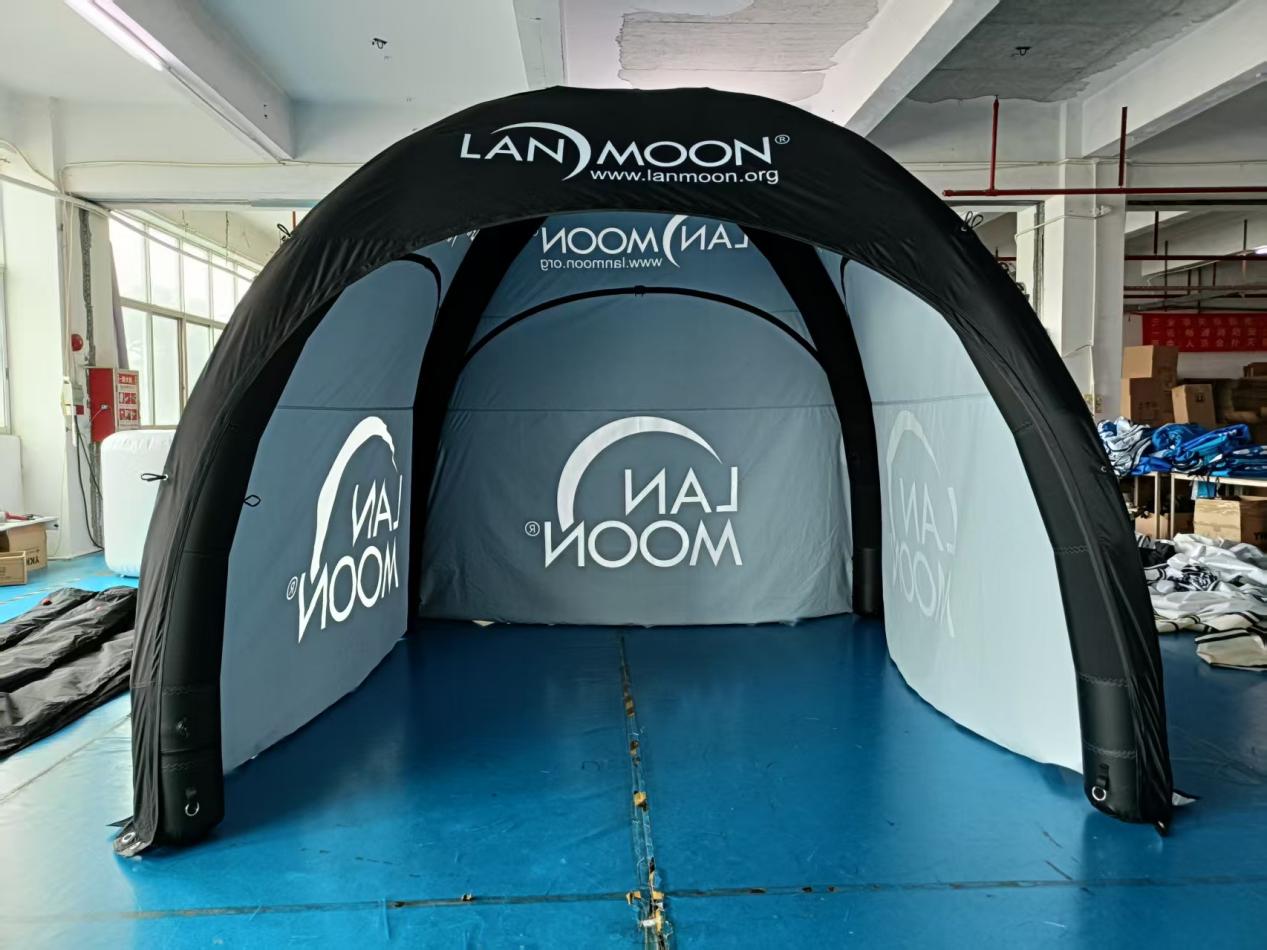
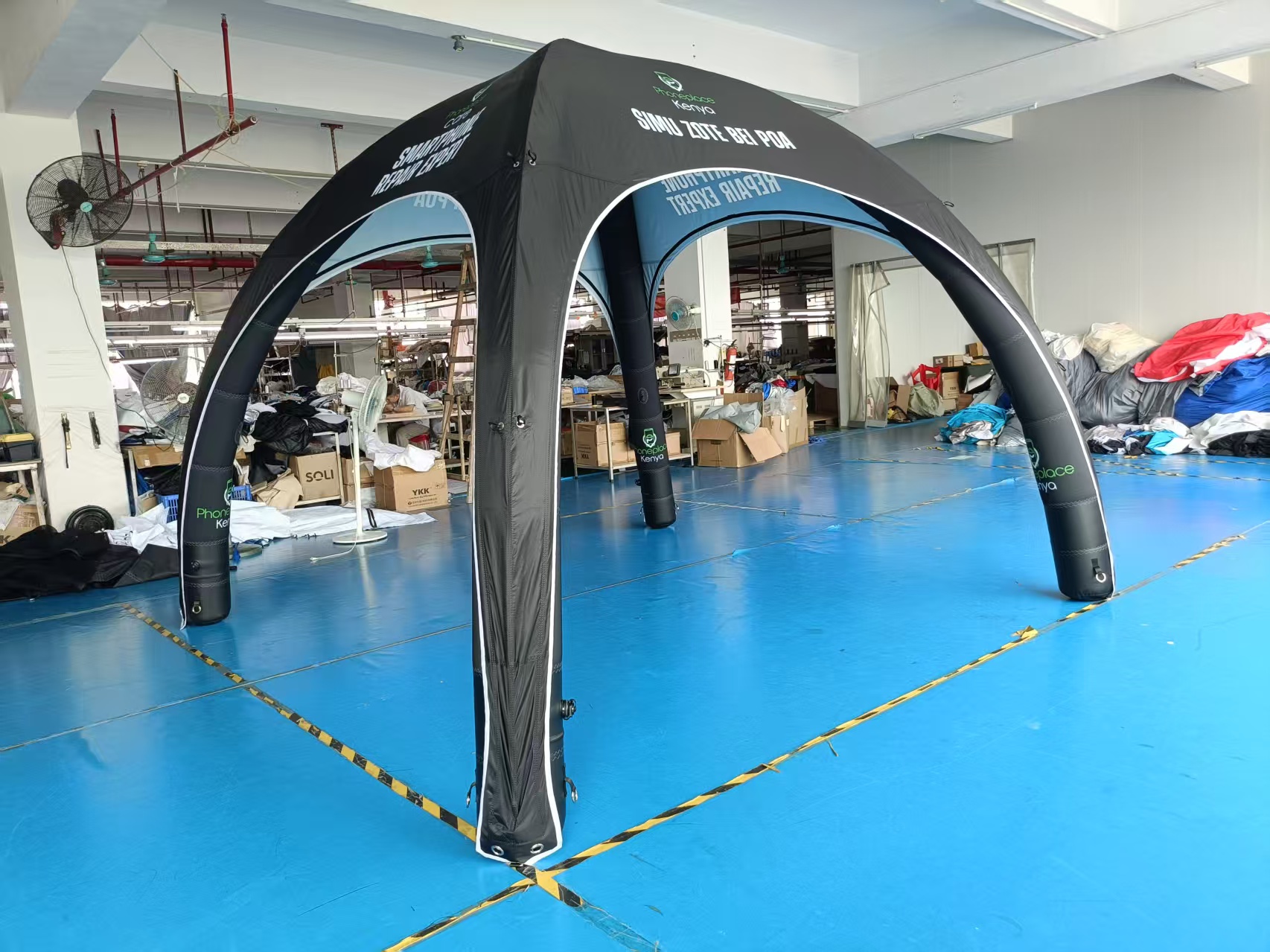
The air columns. Each leg and roof rib is a tube of TPU — a bladder that holds the air — sitting inside a fabric sleeve that carries the print. TPU is used because it flexes without cracking at the fold lines and holds pressure without creeping. The sleeve takes the load and the abrasion; the bladder only has to hold air. That split is why a well-built dome can be inflated, packed and re-inflated for years.
The cover. Panels of oxford cloth are welded to the columns and to each other. Oxford in a standard weave is the default; ripstop is worth the step up when the unit travels constantly, because a small tear stops at the grid instead of running.
The valves. A filler valve to inflate, and a safety valve that releases before the column is over-pressurised. Closed-cell means the air stays in: once the dome is up, the pump is switched off and put away. There is no blower running during the event — which also means no cable across the floor and no noise inside the space.
What actually sets the space inside
Diameter is the number everyone quotes, but three numbers decide whether the dome works:
- Diameter sets the floor area. A circle of 5 m across is about 19.6 m² — enough for a reception counter and two standing-height tables, not enough for a car.
- Total height sets what fits vertically. A dome’s ceiling curves down towards the edge, so the usable headroom is a smaller circle inside the footprint. Count your tallest object, then walk the curve.
- Door opening is the number that gets forgotten, and the one that stops an installation. A wide door costs nothing at the design stage and cannot be added later without rebuilding the panel.
Because every dome is made to order, the practical approach is to fix the door first (what has to go through it), then the height (what has to stand up inside), then the diameter (how many people or tables). Sizes are not chosen from a catalogue; they are set from those three answers.
Printing across a curved surface
A dome is the hardest standard shape to print, because the artwork is designed flat and applied to a surface that curves in two directions at once.
Four rules prevent the usual failures:
Keep the mark off the crown. The top of a dome is seen at a steep angle from eye level, and it compresses visually. Logos placed there look smaller than the proof suggests. Put the primary mark on the vertical band where a standing person actually looks.
Design around the seams and the door. Welded seams, zip lines and the door frame cut through the panel. Text that crosses a seam will break; text that ends near a zip will look cramped. Lay the artwork out with those lines marked on the template.
Use large areas of colour deliberately. Solid colour hides the shading that a curved surface creates; thin lines and small type do not survive curvature. If the brand requires fine detail, keep it on a flat panel — a wall or a counter — rather than on the roof.
Supply vectors, with fonts converted. The file we need is the artwork at final size with outlines, plus the brand colours named. A design preview comes back before production, so the approval step is on a file rather than on a finished unit.
Anchoring: three floors, three answers
Anchoring is where indoor and outdoor projects diverge, and where a venue’s rules matter more than the structure.
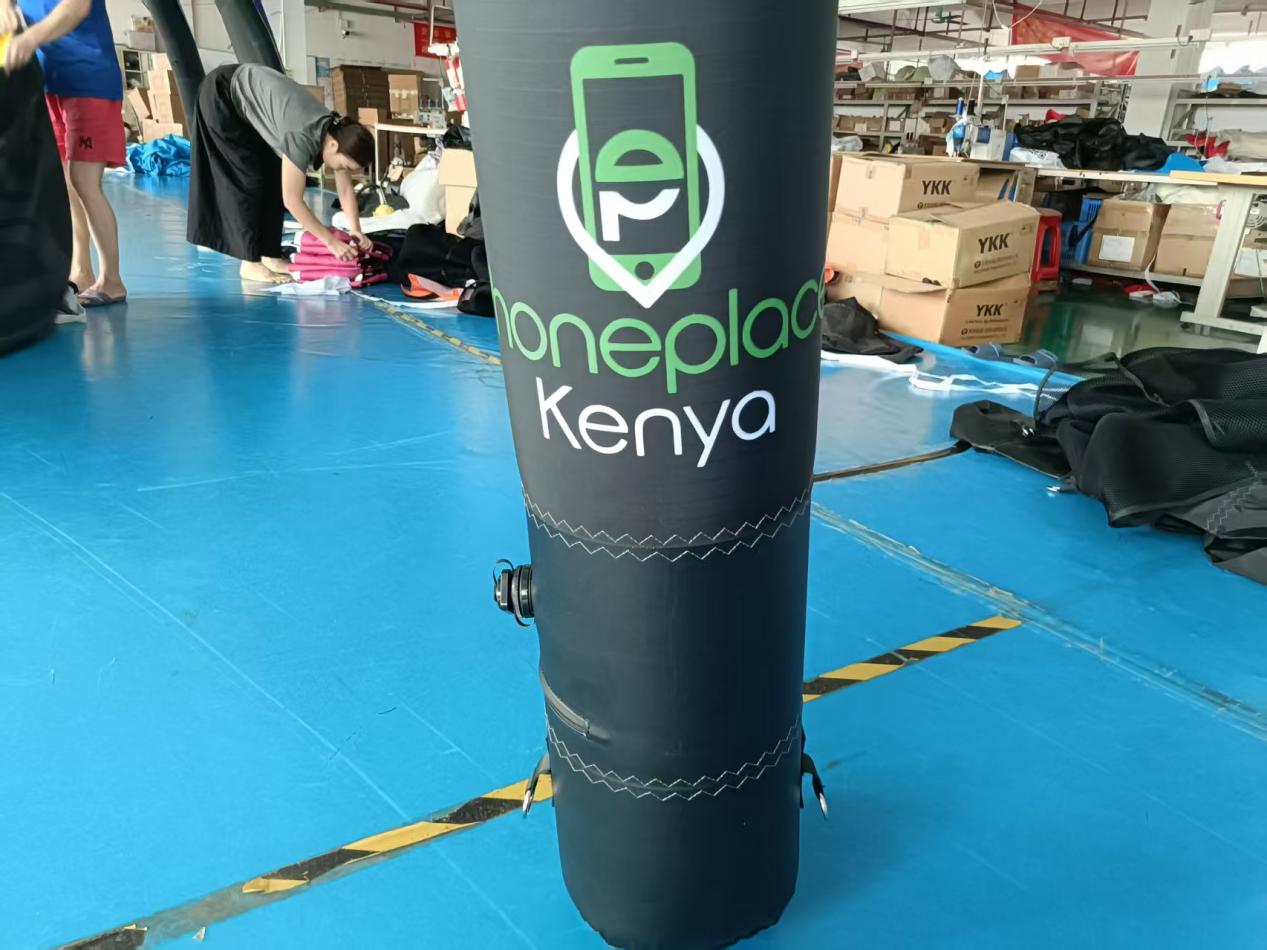
Grass or soil. Ground stakes through the D-rings at each leg, with ropes to the higher anchor points. This is the most forgiving surface and the one most outdoor events use.
Asphalt, concrete, paving. Stakes are useless. The dome is held by ballast — water bags or sandbags on the leg bases and on the rope points — and the load has to be shared, not stacked on one leg. On a hard surface, always ask whether the venue permits ballast and whether the surface can take the weight.
Exhibition halls. Two constraints dominate: floor protection (nothing that marks the carpet or the coating) and circulation. Fire exits, aisle widths and ceiling height are set by the organiser, and a dome is a structure that has to sit inside those rules.
Three questions to the venue before the design is fixed: what is the floor, what is allowed to hold the structure down, and what is the clear height at the installation point. The answers usually decide the leg spacing.
What ships with the unit
Standard: inflation valve, safety valve, storage bag with a separate accessory bag, ground stakes, ropes, and a TPU repair card covering the bladders.
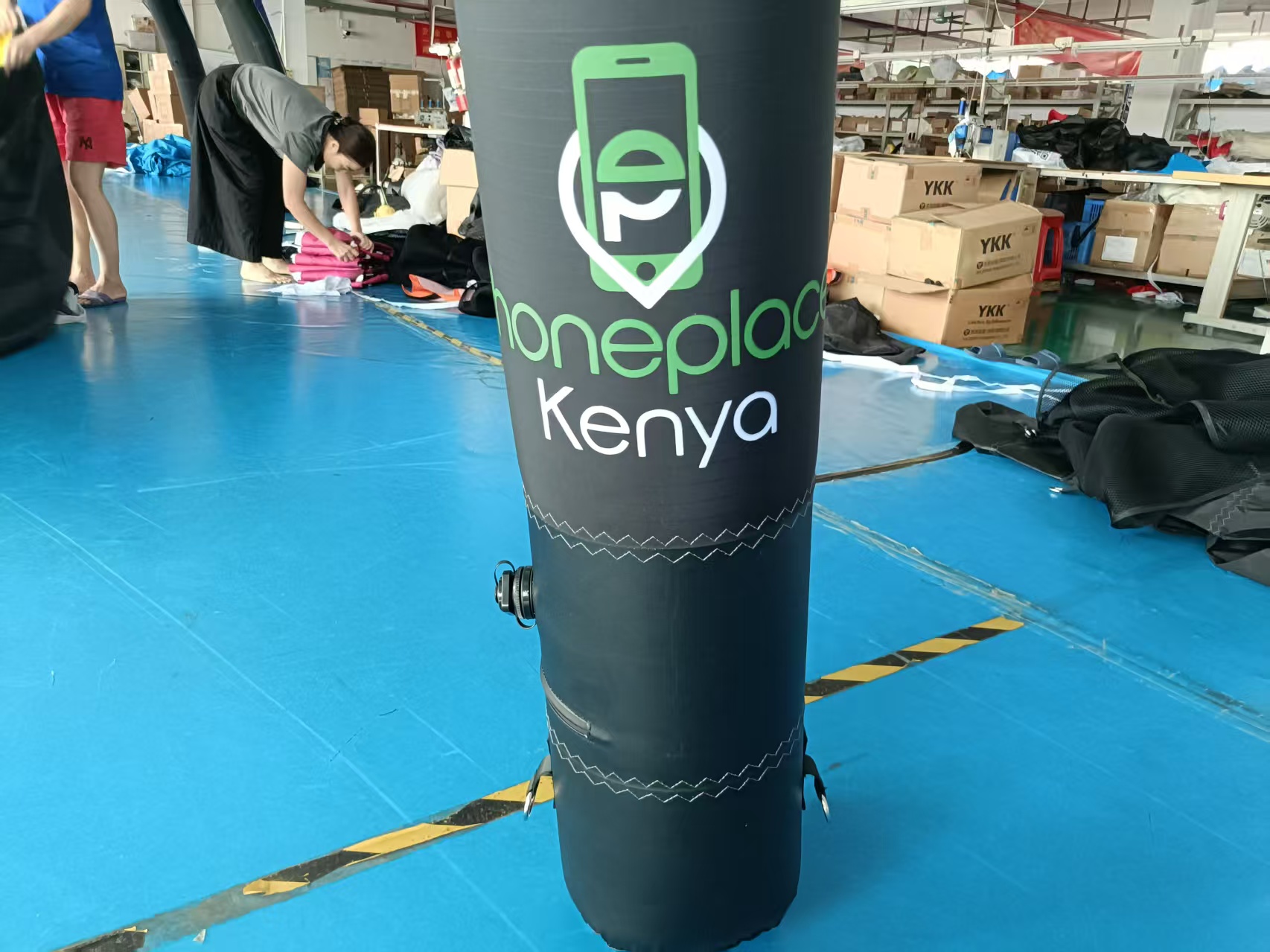
Optional, depending on use: a wheeled storage case for units that move between venues, a carry bag for shorter distances, LED lighting for evening events, sandbags for hard floors, and an electric or manual pump.
The pump matters more than it looks. An electric pump turns set-up into a ten-minute job for two people; a manual pump is the fallback when there is no power on site at all — which happens more often than expected at outdoor pitches.
Dome, inflatable tent or aluminium frame tent
| Criteria | Dome | Infl. tent | Frame tent |
|---|---|---|---|
| Frame | Air columns, closed-cell | Air columns, closed-cell | Aluminium frame, fabric canopy |
| Set-up | Inflated on site, then anchored | Inflated on site, then anchored | Frame assembled, canopy fitted |
| Packed size | Compact, soft, folds into a bag | Compact, soft, folds into a bag | Long bundles, heavier |
| Printable surface | Roof and walls, curved | Walls and roof, flatter | Valance and walls, mostly flat |
| Best for | Brand moments, entrances, hospitality | Service counters, retail pop-ups | Long runs, repeated weekly use, large spans |
The choice is usually settled by two questions: does the unit travel (inflatable wins) and does it need to look like a building rather than a brand object (frame wins).
What a quote needs
Six things remove almost all of the back-and-forth:
- Diameter, height and door opening — or the constraint behind them: how many people, what has to go inside, what has to go through.
- Where it will stand — grass, asphalt or hall floor, indoors or outdoors.
- Artwork, in whatever state it exists — a logo, a reference, a colour direction. What matters is knowing at the start what has to be built.
- Quantity — one unit for a launch, or a set for a touring programme.
- Accessories — lighting, ballast, case, pump.
- The date it has to be on site, not the date of the event.
Production and delivery
Standard production runs 3–7 days from artwork approval. Units ship folded, in the storage bag, with the accessory bag packed separately so that stakes and ropes are not loose in the box.
CE and RoHS documentation is available with the shipment or on request — useful when the dome is going into a venue that asks for it, which exhibition halls increasingly do.
Related reading
- Custom Inflatables for Events: Domes, Arches and Tents — Buyer’s Guide
- Custom Inflatable Tents | Branded Event Domes & Promotional Structures
- A Mobile Retail Counter in Custom Inflatable Tents: Phoneplace Kenya
- Inflatable Finish Line Arch
- Advertising Tent Buying Guide for Wholesale Buyers
- Inflatables in Event Branding: An Animal Shelter Adoption Kit