Most backdrop orders go wrong in the same way: the buyer measures the wall instead of the photograph.
A backdrop is rarely bought to fill a space. It is bought because something has to happen in front of it — two people cutting a ribbon, a speaker at a lectern, a family posing after a ceremony, a product standing on a plinth. The width you need is decided by what will be in that frame, and how much breathing room the camera needs around it. Everything else — the frame, the fabric, the shape — follows.
This guide works through that decision for the five settings we are asked about most, then covers the two specification choices that catch buyers out at the end: straight versus curved, and single versus double sided.
What a Pop-Up Backdrop Actually Is
The term covers a few different things in the market, so it is worth being precise.
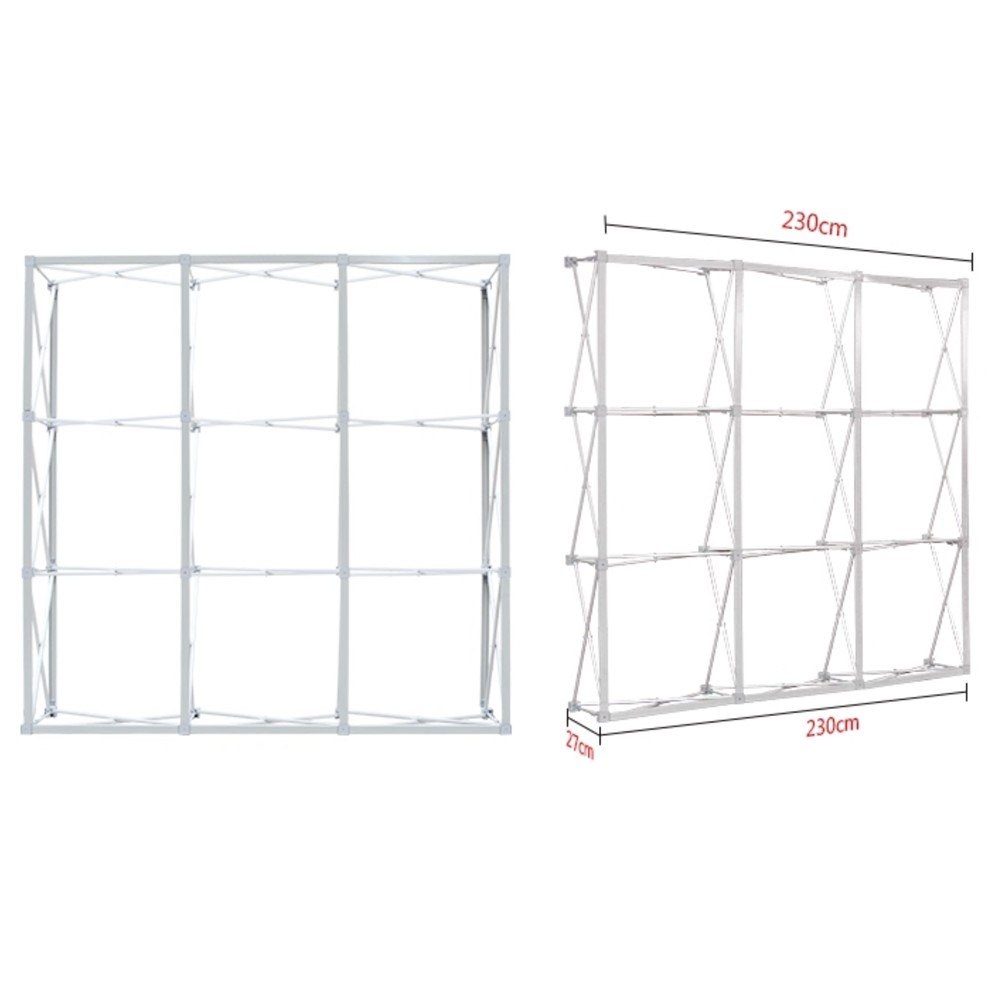
A pop-up backdrop, as we build it, is a freestanding frame with a printed fabric graphic stretched over it. The frame is aluminium alloy and folds out from a compact bundle. The graphic is a single printed fabric panel fitted over the frame face. Setup takes a few minutes and needs no tools, which is the main reason this format has replaced timber and truss walls for travelling events: it goes up, comes down the same day, and travels to the next stop.
Two details matter more than they look on a spec sheet:
- The standard height is 2.3 m. That is above head height for a standing adult, so a group can pose in front of it without heads breaking the top edge, and it still clears the ceiling in most function rooms and exhibition halls.
- The width is made to order. Standard widths run 2.3 m, 2.5 m, 3 m, 4 m, 5 m and 6 m, and the frame is produced for the width you specify.
The same frame accepts a single sided or a double sided graphic, and can be supplied straight or curved.
The frame opens to a full 230 x 230 cm panel and stands about 27 cm deep. Across the range the height stays at 2.3 m — only the width changes.
Start With the Photograph, Not the Wall
Before looking at a tape measure, answer three questions about the image that will be taken in front of it.
How many people stand side by side? An adult at comfortable standing width occupies roughly 60 cm. Two people need about 1.2 m of shoulder-to-shoulder space before any background margin is added.
How much margin does the shot need? A backdrop that is exactly as wide as the group looks cramped and crops badly on a phone. Photographers generally want background visible on both sides of the subjects — enough that the graphic reads as a wall rather than a stripe. A practical minimum is one person-width of clear backdrop on each side.
What else is in the frame? A lectern, a cake table, a product plinth or a sponsor logo row all consume width. A launch setup with a speaker and a product table often needs more wall than a wedding group of the same size, because the furniture cannot be moved closer together.
Run those three numbers and you have a working width. The wall measurement is a constraint to check afterwards, not the starting point.
Sizing by Occasion
Wedding Photo Areas
The most common request, and the one where oversizing wastes money most often.
For a couple plus two to four guests, 3 m is the comfortable choice: it gives the two central figures roughly 1.2 m, leaves clear graphic on both sides, and still fits most marquee and restaurant spaces. 2.5 m works where the room is tight or the backdrop sits in a corner rather than on a flat wall — it still accommodates a couple with a modest margin. 2.3 m is the narrowest practical option and suits a single subject or a couple photographed close, such as a small ceremony or an elopement.
Go to 4 m only if the photo area is also the ceremony focal point, or if guests will be photographed in groups of six or more. Beyond that the extra width reads as empty background in a two-person shot.
One note on curved backdrops for weddings: the curve wraps the couple and photographs beautifully from the centre, but it takes up more floor space than the 27 cm of a straight frame. Measure the position you intend to use and check that a curved unit will not block a fire exit, a service door or a serving route.
Product Launches and Press Events
Launch backdrops carry more information than wedding walls — a logo lock-up, a product name, sometimes a date — and they are usually photographed from further back, so more wall has to fill the frame.
3 m to 4 m covers most launches: 3 m for a single speaker at a lectern, 4 m where two people present together or where a product table sits to one side. If the backdrop is the press photo wall rather than a stage element, size it for the widest group that will stand in front of it — journalists photograph the full width, and a wall that stops short of the group will show in every image.
Exhibition and Trade Show Back Walls
Here the constraint is usually the stand, not the photograph. A standard shell scheme booth is 3 × 3 m (roughly 10 × 10 ft), and a 3 m backdrop sits neatly across the back of it without overhanging into a neighbour’s space.
6 m suits a double-width or end-of-row stand where the backdrop runs the full back wall, and is often used as a branded boundary behind a meeting area. Mid-size stands between those two usually settle on 4 m to 5 m.
Check the organiser’s height and fixing rules before ordering: some venues restrict what can be attached to the shell scheme, and a freestanding frame avoids the question entirely.
Retail Windows and In-Store Displays
Window displays are viewed from a metre or two away and cropped by the frame of the window itself, so a smaller wall does the same job. 2.3 m to 2.5 m is the usual range — wide enough to fill a standard shop window, narrow enough to leave room for product in front.
In-store, the same sizes work for seasonal campaign walls and pop-up corners. Because the frame is freestanding, it can be moved between branches and reused across campaigns rather than discarded after one.
Signing Walls and Step-and-Repeat
A signing wall is read at close range and photographed straight on, so the graphic matters more than the extra width. 3 m is the common choice for a two-person signing moment with a sponsor row; 2.5 m is adequate for a single signatory in a tight lobby.
Single sided is usually enough here, because the wall faces the queue. Double sided only makes sense if guests approach from both directions.
Straight or Curved
Straight is the default and the safer choice. It sits flat against a wall or forms a clean boundary in an open space, packs smaller, and photographs without distortion in a wide shot. Choose it for corner positions, narrow rooms, and any setting where the backdrop needs to disappear into the architecture.
Curved is chosen for the way it frames a subject: the ends come forward and the centre recedes, which pulls the eye to whoever stands in the middle. It suits wedding photo areas, press walls and any setup where the backdrop is the focal point in an otherwise open room. It needs more floor depth, and it will not sit flush against a wall.
If the backdrop will sometimes be used flat and sometimes on its own, straight is the more versatile purchase. Curved is worth specifying when the main use is photographing people centred in front of it.
Single Sided or Double Sided
The same frame carries either one printed graphic or two, back to back.
Single sided is correct whenever the back of the backdrop faces a wall, a storage area, or anywhere guests do not stand. That covers most exhibition back walls, retail windows and signing walls.
Double sided earns its place when the frame stands free in a room: a centre-of-hall photo area, a partition between two zones, or a walkway where people approach from both ends. In those settings a single sided graphic leaves a blank white back facing half the room, which is usually noticed on the day rather than at order time.
The question to ask is simply: can anyone stand behind this and see it? If yes, specify double sided.
Metric to Imperial: A Quick Reference
Our standard widths are metric. Here they are in feet, since a lot of event planning documentation — booth sizes, venue floor plans, photographer briefs — is written in imperial.
| Width (m) | Width (ft) | Typical use |
|---|---|---|
| 2.3 m | 7.5 ft | Retail window, compact corner, single subject |
| 2.5 m | 8.2 ft | Wedding couple in a tight room, in-store campaign |
| 3 m | 9.8 ft | Wedding group, 3 × 3 m booth back wall, signing wall |
| 4 m | 13.1 ft | Product launch with a speaker and product table |
| 5 m | 16.4 ft | Large stand, wide press wall |
| 6 m | 19.7 ft | Double-width stand, full back wall |
Height is 2.3 m — about 7.5 ft — across every width.
One conversion worth remembering: a 3 m backdrop matches a 10 ft booth almost exactly. Buyers working from an imperial floor plan sometimes assume they need a 10 ft panel and end up with a wall that overhangs the stand.
What to Send Us Before Production
Every backdrop is printed to your artwork, so production starts after approval rather than from stock. Five things settle a quotation quickly:
- Width from the list above, or the constraint you are working to.
- Straight or curved.
- Single or double sided.
- Artwork — vector files are ideal; if you only have a bitmap, send the largest version available and we will confirm whether it holds at full size.
- Where it will be used, in one line. It sounds like small talk, but it is the fastest way for us to flag a size that will not work — a 6 m wall in a room with a 2.4 m ceiling, or a curved unit in a space too narrow for the projection.
If you are still deciding between a backdrop and another display format — a roll-up banner, an X-banner or a pop-up stand — our comparison of roll-up, X-banner and pop-up displays sets out which format suits which setting.
Five Specification Mistakes
Measuring the wall and ordering that width. The wall is a limit, not a requirement. A backdrop should be sized to the photograph, then checked against the wall.
Forgetting the furniture. A lectern, cake table or product plinth takes width out of the usable area. Subtract it before choosing.
Choosing curved for a narrow room. The curve projects forward. In a tight space it ends up either blocking circulation or standing further back than the room allows.
Specifying single sided for a free-standing position. If guests can walk behind it, they will, and the back will be blank.
Sending a small artwork file. A graphic that looks sharp on a laptop can soften noticeably across six metres. Send the largest file you have and let us check it before printing rather than after.
Where This Format Fits
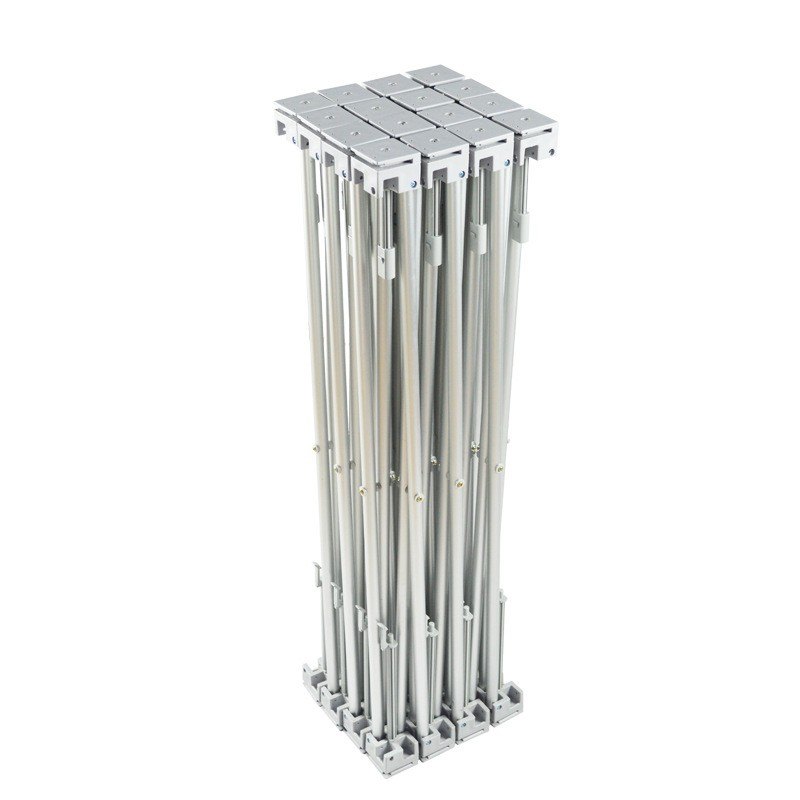
A pop-up backdrop is the right purchase when the same wall has to travel: a roadshow with four stops, a wedding planner who reuses the frame across clients, an exhibition programme where the stand changes but the brand does not. It goes up in minutes, comes down faster, and travels flat rather than in a crate.
It is the wrong purchase when the wall is permanent and never moves — a fixed retail interior or a building lobby is usually better served by a rigid structure.
For a worked example of a backdrop used at a community event rather than a trade show, our animal shelter adoption event display kit shows how the same format was specified alongside flags and table covers for a one-day outdoor programme. A larger exhibition build is documented in our USA exhibition advertising project.
If you have a width in mind — or a photograph you need to fit — send it across and we will confirm the size, shape and print specification. See the backdrop display stand page for the full size range and request a quotation.