Buyers usually treat the attachment as an afterthought — pick a size, pick a fabric, and the flag arrives with whatever the factory puts on the hoist. In practice the attachment is the part that decides whether the flag can be used at all on the pole you already have, and it is the part that fails first.
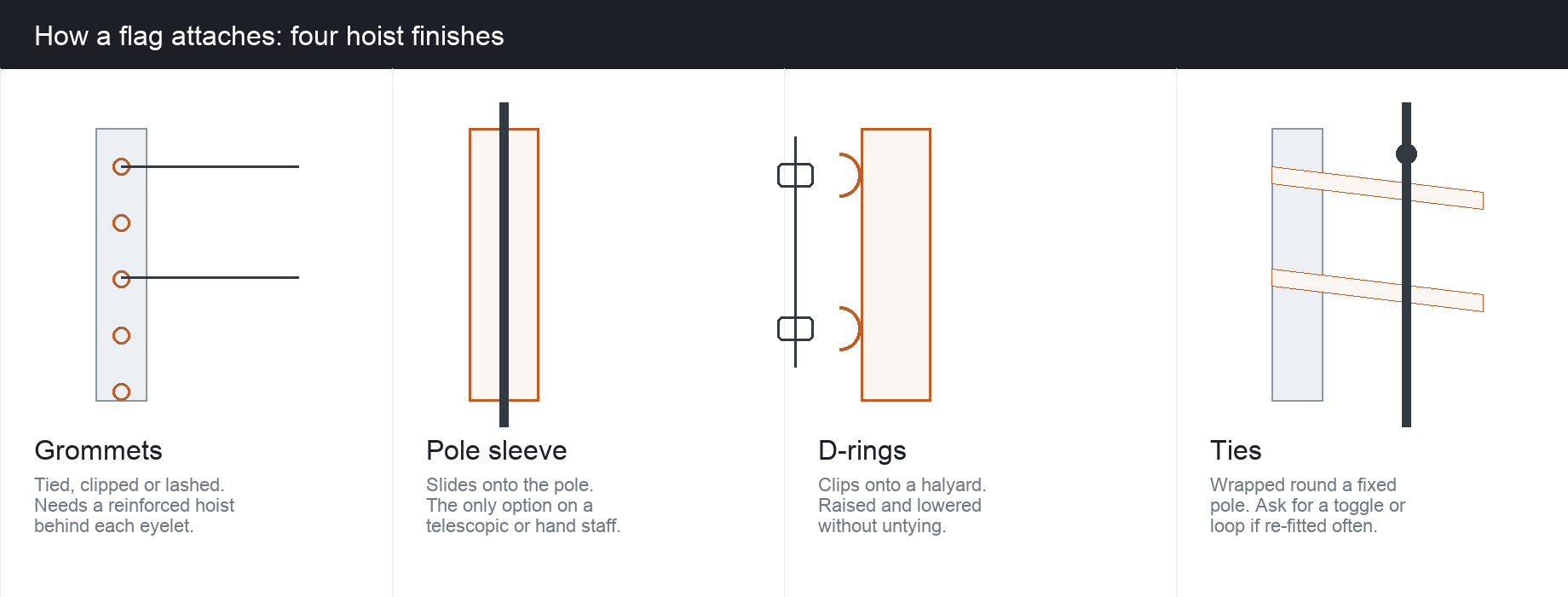
A flag with grommets will not slide onto a telescopic pole. A flag sewn with a sleeve cannot be clipped to a halyard. These are not preferences; they are mechanically different products, and the choice is set by the pole, not by the flag.
The four options, and what each one attaches to
| Method | Fixes to | Normally used on | Watch out for |
|---|---|---|---|
| Grommets | Rope, ties, or clips through the eyelets | Wall mounts, fixed brackets, halyard poles with clips | Bare grommets pulled hard in wind tear out of the cloth; the hoist needs reinforcing behind them |
| Pole sleeve | Slips over the pole itself | Telescopic and hand-held poles, feather and garden flags, staffs | Sleeve must be sized to the pole diameter — too tight and the flag will not swing, too loose and it hangs crooked |
| D-rings | Snap clips on a halyard | Sectional outdoor flagpoles, internal or external halyard | Wear sits at the ring stitching rather than the grommet; the rings must be sewn into a reinforced sleeve |
| Ties | Tied directly around a fixed pole or staff | House poles, indoor display poles, boat staffs | Knots loosen; ties need a toggle or a loop to stay put through the season |
Grommets
The default for anything that gets tied, clipped or lashed to a mount. Two decisions matter:
- Material. Brass for general use; stainless steel where salt or constant moisture is in play — this is the same split we already specify on our marine flags, which carry a heavy hoist with either brass or stainless grommets.
- Reinforcement behind them. A grommet is only as strong as the cloth around it. The flag that survives is the one with a reinforced hoist, not the one with the biggest eyelet.
Grommets suit: wall-mounted poles, brackets, and halyard poles used with clips or rope.
Pole sleeve
A fabric sleeve sewn along the hoist, so the pole passes through the flag. This is the only workable option on a telescopic pole, a hand-held staff, or any flag that has no rope to tie to.
- Sleeve depth must clear the pole. The flag needs to turn freely on the pole; a sleeve that is too tight locks the flag facing one way, and one that is too loose lets it hang out of square.
- Tell us the pole diameter, not just the flag size. The sleeve is built to the pole it will live on.
This is the finish used across our feather and banner flags, which can be supplied with a flag sleeve, eyelets, overlocked edges, or a combination.
D-rings
D-rings are sewn into the sleeve so the flag can be attached to a halyard with snap clips — raised and lowered without untying anything. This is the standard finish for sectional outdoor poles, internal or external halyard, where the flag must come down in weather or at closing time.
Two things drive the spec: the halyard length and pulley stations (which set where the clips land), and the load at the truck. We list flag size and sleeve depth together with the halyard spec when a pole and flag are ordered as a system, because they are one mechanism.
Ties
Fabric ties, or a tie with a toggle, hold the flag against a fixed pole by wrapping the hoist around the shaft. Simple, and the right answer when the flag never comes down — house poles, indoor display poles, staff-mounted boat flags.
The failure mode is loosening. Ask for a toggle, a loop or a velcro option if the flag is going to be re-fitted repeatedly.
The hoist is where flags fail
Whichever attachment is chosen, the load lands in the same place: the hoist, the canvas header along the edge that touches the pole.
This is why we build the hoist, not just the print. Double-stitched hems, a reinforced fly end, and a heavy hoist are the difference between a flag that runs a season and one that comes back with the grommet corners torn out.
And it is why an oversized flag on a light staff is the single most common cause of hardware damage — the attachment carries whatever the flag weighs and whatever the wind puts on it. Keep the flag’s hoist in proportion to the staff or halyard it hangs from.
Matching the attachment to the pole
| If the pole is… | Specify |
|---|---|
| Telescopic or hand-held staff | Pole sleeve, sized to the pole diameter |
| Wall bracket or wall-mounted pole | Grommets, with a reinforced hoist |
| Sectional outdoor pole with halyard | D-rings + snap clips; give us the halyard and pulley spec |
| Fixed house or indoor display pole | Ties, with a toggle or loop for repeated fitting |
| Boat staff or rail mount | Stainless grommets or a sewn sleeve, on a heavy hoist |
What to send with an enquiry
- The pole you already have — type, diameter, and whether it has a halyard.
- The size and the attachment — or tell us the pole and we will match the attachment to it.
- The exposure — salt water, constant wind, or an indoor counter changes the grommet and hoist spec.
- If the flag will be raised and lowered, say so; that is the difference between ties and D-rings.
Send those four and we will quote the flag as a finished product — print, hoist and attachment as one specification — rather than a piece of printed fabric. Custom hoists, sleeve widths and attachment hardware sit under our OEM / ODM service, and replacement halyards, clips and mounting hardware are in the flagpole accessories range.
Get a quotation
Tell us the pole, the size and how the flag will be fixed, and we will confirm the attachment, the hoist spec and the pricing together.